The world was appalled to learn last Thursday of yet another atrocity carried out by al Shabab terrorists in Kenya: 147 students at Garissa University were shot and killed because they indicated they were Christians. In recent years al Shabab has been responsible for killing hundreds of Christians in Kenya. On Good Friday, the Anglican Archbishop of Kenya requested prayer for the grieving families. He also called upon governments to act with wisdom and determination to bring to an end the current terrorism.
But, as I said in my Easter Day sermon at Christ Church New York City, there is a tragic irony. On Wednesday last week, the London Telegraph reported the former British Education Secretary, Michael Gove as saying: To call yourself a Christian in contemporary Britain is to invite pity, condescension or cool dismissal. “In a culture that prizes sophistication, non-judgmentalism, irony and detachment, it is to declare yourself intolerant, naive, superstitious and backward. He was also reported as saying: Christians in Britain are being cowed into hiding their faith for fear of being viewed as a ‘bigots’… or simply fools… Were the students in Kenya simply naïve in saying they were Christians, especially in the face of certain death?
Read
26 A week later his disciples were again in the house, and Thomas was with them. Although the doors were shut, Jesus came and stood among them and said, “Peace be with you.” 27 Then he said to Thomas, “Put your finger here and see my hands. Reach out your hand and put it in my side. Do not disbelieve but believe.” 28 Thomas answered him, “My Lord and my God!” 29 Jesus said to him, “Have you believed because you have seen me? Blessed are those who have not seen and yet have come to believe.” 30 Now Jesus did many other signs in the presence of his disciples, which are not written in this book. 31 But these are written so that you may come to believe that Jesus is the Messiah, the Son of God, and that through believing you may have life in his name.
Reflect –One of the encouraging things about the Christian Bible is its downright honesty – not least about its heroes. Thomas, one of Jesus’ first followers expressed his frustration at the Passover meal when Jesus said he was going away: “We don’t know where you are going. How can we know the way?” Thomas wanted clear and concrete answers to perplexing questions.
He had not been with the other ten when Jesus appeared to them on the day that changed the world – the day of Jesus’ resurrection. This may be why he could not at first accept the fact that Jesus, whom he had seen crucified, was now alive. Unless I see the nail marks on his hands and put my fingers where the nails were… I will not believe, he said.
A week later when Jesus appeared again to the disciples Thomas was present. Jesus responded to Thomas’s unbelief: Put your finger here and see my hands, he said. Reach out your hand and put it in my side. Don’t disbelieve but believe.Unbelief was Thomas’s problem, not ‘doubt’, for doubt is not the opposite of belief. Indeed, Jesus commends the millions who would come to believe without seeing – suggesting that to believe in him is to see.
Thomas, experiencing first hand an unexpected joy, and without touching Jesus, responded, My Lord and my God! It was the testimony of an eyewitness, a perfect confession of faith.
John concludes the chapter by summing up the purpose of his book: These things are written so that you may know that Jesus is the Christ, the Son of God, so that believing you may have life in his name. Jesus had brought Thomas from unbelief to belief, and that belief brought hope.
Let us thank God for the courage the Kenyan students showed last week in declaring their faith in the face of death. Let us pray for the same kind of faith and courage to testify to Jesus and his resurrection.
Prayer –Eternal God, who strengthened Thomas your apostle, when he was disbelieving, with sure and certain faith in the resurrection of your Son our Lord Jesus Christ: so grant that we may not be faithless but believing, until we come to see our Savior in his glory face to face; who lives and reigns with you and the Holy Spirit, one God, now and for ever. Amen. (BCP, Collect for St Thomas’s Day – adapted)
In recent years ‘new atheists’ such as Richard Dawkins and the late Christopher Hitchens have dismissed the miracles of the New Testament as fabrications. And when we think about it, to discredit the New Testament miracles is to discredit, for example, the signs of John’s Gospel and their witness to the uniqueness of Jesus as the Son of God, God in the flesh.
Our approach to the miracles depends on our presupposition. If we believe – and it is a belief – that everything about us is here by chance, then it is unlikely we will accept the occurrence of miracles. If, on the other hand we believe that there is a creator God behind our vast, complex universe, then it is consistent that God, if he chooses, can suspend the natural order of observable laws momentarily for a particular purpose.
Read –John 11:17-27
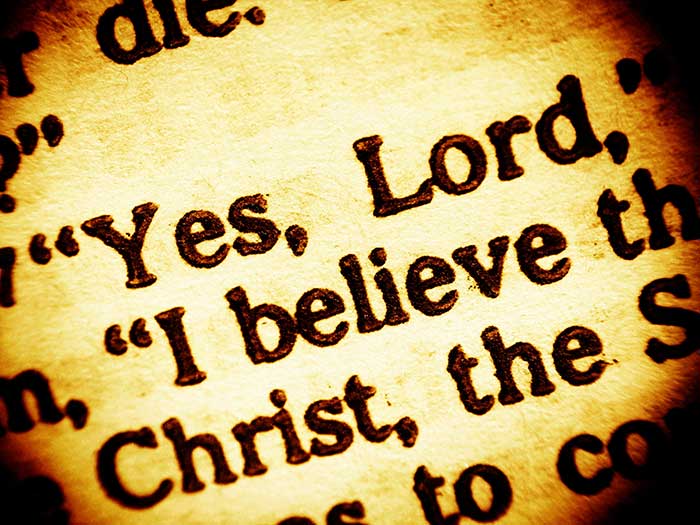
17 When Jesus arrived, he found that Lazarus had already been in the tomb four days. 18 Now Bethany was near Jerusalem, some two miles away, 19 and many of the Jews had come to Martha and Mary to console them about their brother. 20 When Martha heard that Jesus was coming, she went and met him, while Mary stayed at home. 21 Martha said to Jesus, “Lord, if you had been here, my brother would not have died. 22But even now I know that God will give you whatever you ask of him.” 23 Jesus said to her, “Your brother will rise again.” 24 Martha said to him, “I know that he will rise again in the resurrection on the last day.” 25 Jesus said to her, “I am the resurrection and the life. Those who believe in me, even though they die, will live, 26 and everyone who lives and believes in me will never die. Do you believe this?” 27 She said to him, “Yes, Lord, I believe that you are the Messiah, the Son of God, the one coming into the world.”
Reflect –Death is the ultimate irony, the absurd reality of life. Unless Jesus was deceiving Martha that day, he is only person who can do anything about it.
John has been telling us that the Jewish leaders in Jerusalem had attempted to stone Jesus for his apparent blasphemy (John 10:31). Leaving the city he travelled east of the Jordan. There he learned that his friend Lazarus, brother of Martha and Mary, was dying in the village of Bethany, near Jerusalem.
Hearing that Lazarus had died, and against the advice of his disciples who feared the Jewish leaders, Jesus returned to Bethany where he was met by Martha. Talking with her he made the amazing assertion: “I am the resurrection and the life. Those who believe in me, even though they die, will live, and everyone who lives and believes in me will never die.”
He didn’t say, ‘I promise resurrection and life;’ or ‘I procure’ or ‘I bring’, but ‘I am.’ Unless he is one with God his words are nothing but blasphemy. C.S. Lewis commented that Jesus was a liar, a lunatic or telling the truth. Jesus’ own resurrection was the event that changed the lives of the disciples and gave them a joy and a confidence that he is all that he claimed to be. It was their courageous witness, empowered by the Spirit of Jesus that changed the world.
The witness of the New Testament, the evidence of history, the existence of the Christian church all point to the conclusion that Jesus’ words are the truth. As he asked Martha that day, so he would ask you and me today, “Do you believe this?” And, if you do believe this, how will it affect your conversations with work colleagues, friends and family this Easter?
Prayer –Almighty God, you have conquered death through your dearly beloved Son Jesus Christ and have opened to us the gate of everlasting life: grant us by your grace to set our mind on things above, so that by your continual help our whole life may be transformed; through Jesus Christ our Lord, who is alive and reigns with you and the Holy Spirit in everlasting glory. Amen. (BCP, Easter Day)
Our eyesight is something most of us simply take for granted. Yet, when we stop to think about it, sight really is quite remarkable. Our ability not only to touch and taste, hear and feel, but to see our surroundings is astonishing. To observe the changing colors of a sunset or the gradual dawning of a new day is a wonderful experience. To be able to perceive the detail of faces and the expression in the eyes of the person we are talking with is amazing. Sight is truly a remarkable gift.
Read– John 9:1-7
1 As Jesus (he) walked along, he saw a man blind from birth. 2 His disciples asked him, “Rabbi, who sinned, this man or his parents, that he was born blind?” 3 Jesus answered, “Neither this man nor his parents sinned; he was born blind so that God’s works might be revealed in him. 4 We must work the works of him who sent me while it is day; night is coming when no one can work. 5 As long as I am in the world, I am the light of the world.” 6 When he had said this, he spat on the ground and made mud with the saliva and spread the mud on the man’s eyes, 7 saying to him, “Go, wash in the pool of Siloam” (which means Sent). Then he went and washed and came back able to see.
Reflect–
A blind man beggingon the side of the road was a familiar sight in ancient Israel. But this man wasn’t blind because of the dusty roads and disease-laden air. He had been born blind. In answer to the disciples’ question about who was to blame, Jesus responded by pointing to the purpose of the man’s blindness. It was so that God’s power might be revealed. Here and elsewhere Jesus implies that physical ailments are an outcome of living in a world out of step with God.
John describes Jesus’ stunning miracle simply. It is another occasion when Jesus didn’t look for any expression of faith. He just took the initiative and acted. When the man obeyed Jesus’ instructions, he returned seeing. Imagine how this would be reported today. ‘How did you feel?’ he would be asked. But John wants us to focus on Jesus’ action, not the man’s feelings.
SPIRITUAL SIGHT
As John 9 unfolds we observe the way that the man progressed in his understanding of Jesus. Towards the end of the chapter Jesus asked him, ‘Do you believe in the Son of Man?’ and the man’s response is honest, even if somewhat vague, ‘I would believe if…’ Jesus said to him, ‘You have seen him. With your own eyes you have visually seen me, the Son of Man. And now as I speak to you,’ Jesus was saying, ‘I am opening the eyes of your mind and heart. I am giving you a sight of the deeper things of life because of who I am. ‘Do you believe this?’ And the man’s response? ‘Lord I believe.’
Consider this man’s experience. He began by calling Jesus ‘a man’ in 9:11. He then said he is ‘a prophet’ in 9:17. In 9:33 he could say, ‘This man must be from God.’ At the end of the chapter, he worshipped him as ‘Lord’. It’s a picture of the road to faith many people travel.
The miracle is also a parable. We are born spiritually blind. We sense there is something more in life but in our natural state we cannot see. We are blind to God and to what life with him can be like. It is only when Jesus opens the eyes of our soul – our spiritual eyes – that we begin to see the wonders of God and his glory revealed in Jesus Christ. If you ‘see’, then thank the Lord. Pray also for others you know, not condescendingly, but asking that God in his mercy will open their spiritually blind eyes . And plan to invite them to church this Easter.
Prayer –Merciful Lord, let your glory shine upon your Church; so that, enlightened by the teaching of your blessed apostle and evangelist Saint John, we may walk in the light of your truth and come at last to the splendor of eternal life; through Jesus Christ our Lord. Amen. (BCP, St. John the Evangelist)
One of the interesting things that modern science has shown is that the universe fits into a single huge pattern. The same laws that control the fall of an apple, control the orbit of the moon. The same equation that describes the behaviour of an atom, can explain the inferno of the sun. This is why Stephen Hawking and others are looking for a theory of unification. We live in a universe, not a diverse.
Power. Jesus’s signs in John’s Gospel give us pause. The power at work in each event reflects the kind of power that lies behind the universe. Jesus’ creative ability to turn ordinary water into top quality wine in a moment, his healing from a distance of young boy at death’s door, his healing of a man paralysed for thirty-eight years, are all signs of a power far beyond the ordinary. It is supernatural. It all suggests that Jesus who walked in ancient Israel might be the logic, the intelligence, the wisdom who gives the universe its existence and rationality.
Read – John 6:1-15
1 After this Jesus went to the other side of the Sea of Galilee, also called the Sea of Tiberias. 2 A large crowd kept following him, because they saw the signs that he was doing for the sick. 3 Jesus went up the mountain and sat down there with his disciples. 4 Now the Passover, the festival of the Jews, was near. 5 When he looked up and saw a large crowd coming toward him, Jesus said to Philip, “Where are we to buy bread for these people to eat?” 6 He said this to test him, for he himself knew what he was going to do. 7 Philip answered him, “Six months’ wages would not buy enough bread for each of them to get a little.” 8 One of his disciples, Andrew, Simon Peter’s brother, said to him, 9 “There is a boy here who has five barley loaves and two fish. But what are they among so many people?” 10 Jesus said, “Make the people sit down.” Now there was a great deal of grass in the place; so they sat down, about five thousand in all. 11 Then Jesus took the loaves, and when he had given thanks, he distributed them to those who were seated; so also the fish, as much as they wanted. 12 When they were satisfied, he told his disciples, “Gather up the fragments left over, so that nothing may be lost.” 13 So they gathered them up, and from the fragments of the five barley loaves, left by those who had eaten, they filled twelve baskets. 14 When the people saw the sign that he had done, they began to say, “This is indeed the prophet who is to come into the world.” 15 When Jesus realized that they were about to come and take him by force to make him king, he withdrew again to the mountain by himself.
Reflect – On the occasion we read about here, Jesus stunned everyone by producing sufficient food for a crowd of 5,000 from five loaves of bread and three fishes. It was Passover time, the time when everyone remembered the liberation from Egypt God had provided for his people.
We can only begin to feel the significance and impact of the crowd’s response: “This is indeed the prophet who is to come into the world.” They saw Jesus as a ‘Moses’. Could he liberate them from Roman rule? But, in his withdrawal from the crowd (6:15) we see he had another plan.
SPIRITUAL FOOD
More than a prophet.…You are looking for me, not because you saw signs, Jesus commented, but because you ate your fill of the loaves. Do not work for the food that perishes, but for the food that endures for eternal life, which the Son of Man will give you (John 6:26-27)
There are two kinds of bread, Jesus is saying – bread for our physical bodies and bread for our spiritual existence. One day our physical bodies will die. Jesus knew that because we are much more than the sum of our material parts, we need someone to provide food for our spiritual sustenance. Jesus doesn’t just see empty stomachs, but empty souls, empty lives.
Food. The miracle of turning the bread and the fish into more than sufficient food to feed the crowd was a sign of Jesus’ capacity to feed our deeper spiritual need and give us food for life.
Prayer – Raise up your great power, Lord, and come among us to save us; so that, although through our sins we are grievously hindered in running the race that is set before us, your plentiful grace and mercy may speedily help and deliver us; through the sufficiency of your Son our Lord, to whom with you and the Holy Spirit be honor and glory, now and for ever. Amen. (BCP, Advent 4 – adapted)
Have you ever found that someone has misinterpreted something you have said? You say one thing and they hear you say something different. Often we are misunderstood because others haven’t listened carefully or because they have come to the conversation with their own preconceptions. It can be disappointing, frustrating and sometimes hurtful.
JUST A GOOD MAN?
People’s estimate of Jesus Christ often falls into this category. Many agree he is a good man, even a great man. They may agree he is the most impressive teacher who has ever lived. Who would want to quarrel with his ethic, ‘Love your neighbor as yourself;’ ‘Turn the other cheek;’ or ‘Sell what you have and give to the poor…’? And, the quality of his life was consistent with his teaching. Here was a leader worth learning from, and following. The question we are asking this Lent is whether he is more than a good man.
Read – John 5:2-9
2 Now in Jerusalem by the Sheep Gate there is a pool, called in Hebrew Beth-zatha,which has five porticoes. 3 In these lay many invalids—blind, lame, and paralyzed. 4/5 One man was there who had been ill for thirty-eight years. 6 When Jesus saw him lying there and knew that he had been there a long time, he said to him, “Do you want to be made well?” 7 The sick man answered him, “Sir, I have no one to put me into the pool when the water is stirred up; and while I am making my way, someone else steps down ahead of me.” 8 Jesus said to him, “Stand up, take your mat and walk.” 9 At once the man was made well, and he took up his mat and began to walk.
Reflect – Seeing emergency rooms full of sick people is heart wrenching. We want someone to do something. The opening scene in John 5 tells the sorry story of many invalids – blind, lame and paralyzed gathered around a pool in Jerusalem. Archaeological research suggests that it is a complex of pools with five porticos known as Bethzatha, located near St. Anne’s Church in the Arab quarter today in the Old City of Jerusalem. The pool was thought to have miraculous powers.
On the day Jesus was there, John tells us, there was a man who had been lame or paralyzed for thirty-eight years. Seeing the man and knowing his plight, Jesus asked him a simple question: “Do you want to be made well?” But the man’s response was circumlocutory: “Sir, I have no one to put me into the pool when the water is stirred up…” Perhaps he reckoned that if he was healed he would lose the support and companionship he enjoyed and on which he had come to depend. He’d have to make a new start in life…He’d have to get a job! Without discussing whether the pool had healing powers or not, Jesus took the initiative and, at a word, cured him. The bed that had carried the man could now be carried by the man.
WELLBEING
The man’s hesitant response illustrates the way we sometimes respond to Jesus. He asks us, ‘Do you really want to be changed?’ So often we don’t want him to intrude on our lives and lifestyle. But, in a world that fears the future, men and women need hope, not platitudes; salvation, not sentimentality. Jesus is not offering us affirmation of human dignity in the face of an indifferent universe. He offers each one of us personal access into a new and better universe because he is divine.
So he invites us to make a decision. ‘Do you want to be made well?’ he asks. We may join the ranks of the skeptics and deny him, or we may place our faith in him and join the ranks of those believers who are proving the truth of his promise. Like Thomas, who doubted when he saw Jesus taken away and put to death, we come to worship him: “My Lord, and my God.”
Prayer – Blessed Lord, you have caused all holy scriptures to be written for our learning, grant us so to hear them, read, mark, learn and inwardly digest them, so that, encouraged and supported by your holy Word, we may embrace and always hold fast the joyful hope of everlasting life, which you have given us in our Savior, Jesus Christ. Amen. (1662 BCP, Advent 2)