Elections remind us how much we long for a leader who will bring us justice and peace, protection and prosperity. However, on every occasion our aspirations are dashed as leaders reveal their flaws and failures and self-interest. No one proves to be the leader we long for.
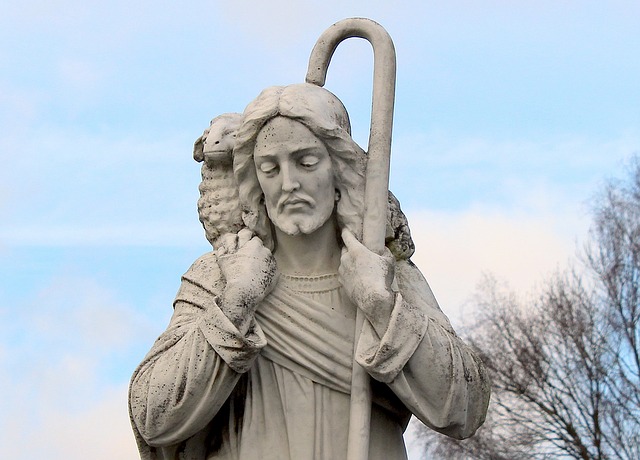
There is one exception: Jesus, who said, “I am the good shepherd. The good shepherd lays down his life for the sheep”(John 10:11).
We tend to view shepherds as romantic figures who spent most of their time cuddling lambs and roaming hillsides with faithful dogs. However, that is a false picture of a shepherd in Israel. They lived dangerous lives.
Jesus, in saying he is the Good Shepherd, brings together shepherd as a metaphor for the Messiah and the idea of death. False messiahs took the lives of men and women. Jesus the true Messiah gives life to men and women at the cost of his own. Consider what we read in John 10:15: “…Just as the Father knows me and I know the Father; and I lay down my life for the sheep”.
The word good is not the usual word that describes, for example, the efficiency of a good car, or the moral uprightness of a good person. Rather, it is the magnetism of the personal goodness of Jesus that draws men and women to him. People understand that he really cares for them.
Nowhere is this goodness better seen than in Jesus’ willingness to die on our behalf. He was not just a do-gooder, for often ‘do-gooders’ aren’t really interested in others, but only in themselves and what others think of them. Jesus is genuinely concerned about us because he really wants us to enjoy life to the full.
Which brings us to something we easily overlook: his death was planned. In John 10:14f we read: “I am the good shepherd. I know my own and my own know me, just as the Father knows me and I know the Father; and I lay down my life for the sheep.”
As Jesus looked out on the world his eyes, as it were, saw through time and space. Everywhere he saw people who in some very intimate way belonged to him, and whom he calls, ‘My sheep’. They are not just a faceless multitude.
Furthermore, he speaks of other sheep outside the fold – people from the non-Jewish nations. ‘They will hear my voice’, he says. ‘And there will be one flock and one shepherd.’
Significantly he tells us that his death was a saving death. We read this in verses 11 and 15 where he says his death was for the sheep. This is important, for some suggest that Jesus died to set the sheep an example of unselfishness. It’s certainly true that a shepherd’s death in the course of duty does reveal his unselfishness.
The key to understanding his meaning is found in the preposition ‘for’. In this instance it has the sense of ‘on behalf of’. Jesus says that his death was ‘on behalf of’ or, ‘instead of’ the sheep.
We begin to see why we need this Good Shepherd and not a professional do-gooder. We need the kind of shepherd who is willing to take our death from our shoulders and bear it himself. That is what Jesus meant when he said that he was the Good Shepherd and gives his life for the sheep. He didn’t die just to prove how much he loved us. He died to save us from death itself.
Let me ask, have you personally heard the voice of the Good Shepherd? And having heard it, do you trust him with your life and follow him? That is what Jesus calls us to, a life of discipleship – a life with the people who respond to his call.
I can’t tell you where that life may lead. I cannot say that life will be a bed of roses, or that all the problems you are aware of will evaporate overnight. But one thing I can promise, because Jesus, the Good Shepherd promises it: you will find his leadership perfectly satisfies all your longings.
Prayer: Almighty and everlasting God, in tender love towards humankind you sent your Son, our Savior Jesus Christ, to take our nature upon him and to suffer death on the cross, so that all should follow the example of his great humility. Grant that we may follow the example of his suffering, and also be made partakers of his resurrection; through him who lives and reigns with you and the Holy Spirit, now and for ever. Amen. (BCP, Sunday next before Easter)
Music is one of the delights of the Christian faith.Indeed, in Colossians 3:16 Paul the Apostle exhorts God’s people to sing. Keith and Kristyn Getty ofGettymusic, will lead ‘worship’ as well as workshops on music and church – how God’s Word spoken and in song can build effective, outreaching churches for adults and children in today’s culture.
At a time when many people have never heard, and so many don’t know what to believe, we aim to explore practical ways to develop more effective gospel-focused churches.
Blaise Pascal, 17th-century French mathematician and philosopher asked: ‘Is life simply a journey… a great mysterious search for the unknown and unknowable? We desire truth and find in ourselves nothing but uncertainty. We seek happiness and find only wretchedness and death. We are incapable of not desiring truth and happiness and incapable of either certainty or happiness.’
It is one of life’s ironies that men and women choose to reject the voice of a man who stands unique in history. I’m speaking of Jesus. Yet, ironically, despite the riches of his teaching, the depth of debate he brought against some of the sharpest minds of his day, the remarkable powers and compassion he showed for people in need, many of ‘the elites’ today reject him – usually on the basis of secondary opinion.
In the interests of recovering the words of Jesus himself, let me quote John 10:7-10:
So again Jesus said to them, “Very truly, I tell you, I am the gate for the sheep. All who came before me are thieves and bandits; but the sheep did not listen to them. I am the gate. Whoever enters by me will be saved, and will come in and go out and find pasture. The thief comes only to steal and kill and destroy. I came that they may have life, and have it abundantly…”
I AM THE GATE
These are amongst the most startling words we find in John’s Gospel. In saying, “I am the gate”,
Jesus distinguishes himself from others, who are not just rivals, but thieves and robbers – criminals.
Who were these people? The Jewish leaders of his day were his contemporaries – they didn’t come before him. Rather, Jesus is referring to the false messiahs who had arisen in Israel and with whom he was constantly in danger of being confused. We know from other sources that there were many charismatic leaders in the century or so before Jesus’ ministry.
It’s not surprising Jesus references them because he was so unlike the political and religious activists of his day. John the Gospel writer wants us to understand this. He doesn’t want us to think that Jesus was a political Messiah. He certainly was not.
We see the force of Jesus’ words: the false messiahs used violence. They attempted to free Israel from Rome’s rule by revolution. Most of them were freedom fighters, even terrorists. Sometimes they even spoke in messianic terms; some even used the title, ‘Shepherd’, because Ezekiel had used this term in speaking of the Messiah.
When Jesus said, “All who ever came before me are thieves and robbers” he was saying that everyone who had claimed messianic titles had been imposters. So when he says, “I am the gate”, he is saying that he is the only one who is the true Messiah. The way to the promised Kingdom of God, and therefore to life, is through him alone.
When we think about it, Jesus’s words have a direct relevance for us today. The only real hope for a future that liberal progressivism has to offer is some kind of humanistic utopia – which can only be temporary at best.
Indeed, there are hints of Karl Marx’s thinking when he said people could only discover their true happiness or fulfillment through liberating themselves from economic oppression and exploitation. He taught that only when all the old alienations are dissolved could men and women be free to develop their full human potential.
The false messiahs in Jesus’ day had a similar theme. For them imperialism was the problem. ‘If we can overthrow the Romans then the kingdom of God will arrive.’
DON’T BE DUPED
It’s against this false messianic voice that Jesus speaks. ‘Don’t be duped’, he says. ‘These people have no respect for personal property – they come to steal. They have a ruthless indifference to human life – they come to silence, and if necessary, to kill. They have an irrational contempt for anything of value – they come to destroy.’
The 20th century witnessed the appalling criminality of revolutionary movements. Millions perished under Lenin, Stalin, and Mao, under Pol Pot and Idi Amin, not forgetting Hitler. Yet no perfect society of peace and justice has emerged.
In fact, Jesus’ words are vindicated. And even more so through his death and resurrection! The progressive humanist dream of a radically new society will not provide long-term, satisfying answers to our questions about life.
“I am the gate,…” Jesus said. He, and nobody else, has come that we might have life. When we go his way we find true liberty – we can come and go; we find true deliverance – we are rescued from the curse of self; we find meaning and fulfillment – we find pasture. Significantly, to fulfil his words Jesus didn’t wield a sword: he carried a cross.
Prayer: Almighty God, the protector of all who put their trust in you, without whom nothing is strong, nothing is holy: increase and multiply your mercy upon us, so that with you as our shepherd, ruler and guide, we may so pass through things temporal that we finally lose not the things eternal: grant this, heavenly Father, for the sake of our Lord Jesus Christ. Amen. (BCP, Trinity 4 – adapted)
In her recent Wall Street Journal article (03/18/17), Peggy Noonan referred to ‘the observation that a great leader has more in common with an artist than an economist. Economists drill deep in narrow fields, but the artist’s view is more expansive; he’s more able to grasp the big picture, and see how it is changing’.
Any serious consideration of Jesus challenges us with the evidence that he is not just ‘a great leader’ but an exceptional one, who grasps life’s ‘big picture’.
H. G. Wells, historian, and author ofbooks such as The Time Machine and The War of the Worlds, once remarked: ‘I am a historian. I am not a believer, but I must confess as a historian that this penniless preacher from Nazareth is irrevocably the very centre of history. Jesus Christ is easily the most dominant figure in all history’.
In John’s Gospel, we read:
Again Jesus spoke to them, saying, “I am the light of the world. Whoever follows me will never walk in darkness but will have the light of life” (John 8:12).
When Jesus said this he was in the Jerusalem temple for the Feast of Tabernacles. A feature of the festival was the lighting of four huge elevated bowls filled with oil. The light they gave was spectacular. They symbolized the great day of God’s Messiah.
Again his words “I am…” stand out. Again he claims to be one with the God who revealed his name to Moses as, “I am who I am” (Exodus 3:14). As thelight of the world Jesus invites everyone to come out of the darkness of self-absorption and turn to the true light that uniquely shines from God.
LIGHT AND TRUTH
Light is a metaphor for truth – which includes moral attitudes and actions. Later he tells us that he is committed to truth and is himself the truth(John 14:6). He also calls on us all to live in the light of his truth. When we think about it, we can’t experience great relationships at any level – with God or with another human being – unless they are framed in truth.
Because our age insists on political correctness and tolerance we easily lose the impact of Jesus’ imagery. We don’t see the moral darkness of life around us. Yet when we digest Jesus’ words here we feel the weight of how far we all fall short of the God standard.
Significantly, he promises us freedom: “…If you continue in my word, you are truly my disciples; and you will know the truth, and the truth will make you free” (John 8:31-32).
FREEDOM IS SOMETHING WE ALL LONG FOR
Yet, when we rightly understand it we see that freedom is not the absence of all constraints, but submission to the right constraints. It is not the rebellion that recognizes no authority, but the discernment that distinguishes legitimate authority. As someone observed, ‘true freedom is not the license to do as we please, but the liberty to do as we ought’.
We need to relearn this vital distinction, for we are all in danger of failing to observe the difference between exercising liberty and taking liberties. Jesus is telling us that true freedom is bound up with knowing him. This is why he wants us to continue in his word.
We’ve already noticed his insistence on our need to know the truth – about who God is and what he expects of his people. This truth is not just head knowledge. It is a knowledge that awakens, drives and frames our relationship with God and our relationships with one another, impacting our mind, conscience, will and heart. So, as with any relationship, we need to work at knowing God better through his special written self-revelation in the Bible.
Furthermore, as with any relationship, we need to persevere with it, even when things don’t seem to be going our way. Jesus is not asking us to join him in a one hundred yards sprint, but in the marathon of life. The extraordinary thing is that when we do this he, being the leader he is, frees us from our bondage to self-interest and sin and opens our lives up increasingly to develop a world-view through his lens, and so enjoy life as we were meant to live it.
Prayer – Almighty God, give us grace so that we may cast away the works of darkness and put on the armor of light now in the time of this mortal life, in which your Son Jesus Christ came amongst us in great humility: so that on the last day, when he comes again in his glorious majesty to judge the living and the dead, we may rise to life immortal; through him who lives and reigns with you and the Holy Spirit, now and for ever. Amen. (BCP, Advent – adapted)
We can think that to have doubts is to lack faith. But doubt is not the opposite of faith. To suggest that it is, is to confuse doubt with unbelief. Doubt is something only a believer can experience, for we can only doubt what we believe. Doubt is to belief, what temptation is to sin – a test.
In fact, in those times when we have to engage with doubt, honestly and frankly, we find our relationship with God grows stronger and more intimate as a result.
BREAD OF LIFE
One of Jesus’ extraordinary statements was that he could offer life: “Anyone who hears my word and believes him who sent me has eternal life… has passed from death to life,” he said (John 5:24).How could he say this?
On one occasion he stunned everyone by producing sufficient food for a crowd of five thousand from five loaves and two fish. The time when Jesus performed this miracle was Passover – the time when everyone remembered God’s liberation of his people from Egypt. We can understand the crowd’s response, “This is indeed the prophet who is to come into the world.” They saw Jesus as a modern-day Moses – someone who could free them from Roman rule. But, having a bigger and better plan, Jesus withdrew from them (John 6:15).
In fact, Jesus commented: “…You are looking for me, not because you saw signs, but because you ate your fill of the loaves. Do not work for the food that perishes, but for the food that endures for eternal life, which the Son of Man will give you” (John 6:26-27).
There are two kinds of bread – bread for our physical bodies that will one day die; and bread for our spiritual existence that is destined to last forever. ‘You have seen a miracle,’ Jesus said, ‘but you do not see the sign.’
Jesus doesn’t just see empty stomachs, but empty souls, empty lives. The miracle of turning the loaves and fish into more than sufficient food to feed the crowd was a sign of Jesus’ capacity to feed our deeper spiritual need and give us life.
UNBELIEF AND DOUBT
In John 6:60-69 we read:When many of his disciples heard it, they said, “This teaching is difficult; who can accept it?” But Jesus, being aware that his disciples were complaining about it, said to them, “Does this offend you? Then what if you were to see the Son of Man ascending to where he was before? It is the Spirit that gives life; the flesh is useless. The words that I have spoken to you are Spirit and life. But among you there are some who do not believe.” For Jesus knew from the first who were the ones that did not believe, and who was the one that would betray him. And he said, “For this reason I have told you that no one can come to me unless it is granted by the Father.”
Jesus was a controversial figure. As people came to know him better they were strongly divided in their opinions about him. So, whereas they had begun to come to him in thousands when they saw and experienced his amazing healing powers, large numbers turned away from him when he challenged them with the deeper issues of life and what he had to offer. Number crunchers today might say his ministry was a failure.
Disbelief and doubts arose when Jesus said of himself, “I am the bread of life”(John 6:35). In the conversation that follows, it is clear that Jesus’ hearers didn’t get it when he contrasted the experience of life now – one that perishes – and the experience of life eternal.
‘Which life is the one really worth working for?’ is his challenging question. But his hearers then, as we can be today, were too focused on life now and finding political solutions.
As the crowds departed, Jesus challenged the Twelve: “Do you also wish to go away?” We can feel the intense sadness of the moment for him. It is a sadness that all faithful ministers of God’s Word experience when people refuse to listen to God’s truth.
Responding on behalf of the Twelve, Peter said, “Lord, to whom can we go? You have the words of eternal life. We have come to believe and know that you are the Holy One of God.” It’s the response of someone who, as we see elsewhere has real doubts, but who by God’s grace, believes.
Collect – Almighty God, we confess that we have no power of ourselves to help ourselves: keep us outwardly in our bodies and inwardly in our souls, so that we may be defended from all adversities that may happen to the body, and from all evil thoughts that may assault and hurt the soul; through Jesus Christ our Lord. Amen. (BCP, Lent 2 – adapted)
Everyone has regrets. We regret the words we let fly and never live down; the opportunities we messed up or ones we never took up; relationships we let slip and ones we should never have begun. There are all those past actions for which ‘redemption’ seems impossible.
The playwright Arthur Miller, put it this way, ‘Maybe all one can do, is hope to end up with the right regrets’. A woman at a well in Samaria two thousand years ago would have agreed.
Like us, she longed for happiness but it had eluded her. Five failed marriages testified to that. Thinking that love and marriage would give her life meaning and happiness, she thought that each new man was Mr. Right. But each time she made the same mistake. Her life was a mess. She felt insecure, lonely, and dissatisfied.
But there came a day when her life was transformed through a conversation with a Jewish man. Transgressing social taboos, Jesus initiated a conversation with her through a simple request for water from the well. He didn’t talk about her life or matters of faith – at least to begin with. Rather he spoke then, as he speaks to us today, with concern and respect. However, it wasn’t long before he took the conversation further by speaking about living water. It opened up the opportunity to talk about her regrets.
In John 4:12-15 we read:
Jesus said to her, “Everyone who drinks of this water will be thirsty again, but those who drink of the water that I will give them will never be thirsty. The water that I will give will become in them a spring of water gushing up to eternal life.” The woman said to him, “Sir, give me this water, so that I may never be thirsty or have to keep coming here to draw water.”
REGRETS
Jesus offered her water that would satisfy her deep inner spiritual thirst. He was saying that he is the answer to the regrets and emptiness that gnaw our souls.
Most of us aren’t willing to acknowledge this – and the woman that day was no exception. We pretend we’re doing well, but the reality is that we often live closer to despair than we admit. So we endeavor to offset our sense of emptiness by filling our social calendar, making money, being ‘a success’, even pursuing sexual adventure. But it never works.
No matter how successful we are, no matter how intense the emotional relationships we might experience, nothing can be a substitute for the relationship with God for which we were made. If we are going to find Jesus’ answer to our regrets, first we have to acknowledge our need.
Jesus said to her, “Go, call your husband, and come back.” The woman answered him, “I have no husband.” Jesus said to her, “You are right in saying, ‘I have no husband’; for you have had five husbands, and the one you have now is not your husband. What you have said is true!” The woman said to him, “Sir, I see that you are a prophet…” (John 4:16-19)
Suddenly she realized that Jesus, whom she had taken for a progressive Jewish man, was nothing less than a prophet with supernatural knowledge of her sin. She knew enough about religion to realize that she was being challenged to sort out her relationship with God.
The big question was where to do this–the temple in Jerusalem, or a house of worship in Samaria? Jesus’s response is, in today’s world, politically incorrect: “You worship what you do not know; we worship what we know, for salvation is from the Jews. But the hour is coming, and is now here, when the true worshipers will worship the Father in spirit and truth, for the Father seeks such as these to worship him. God is spirit, and those who worship him must worship in spirit and truth” (John 4:22-24).
REDEMPTION
Only when we receive the spiritual life that Jesus brings us can we become true worshippers of God, beneficiaries of this living water. It involves a heart response to Jesus.
The woman responded, “I know that Messiah is coming” (who is called Christ). “When he comes, he will proclaim all things to us”.Jesus’s words are breath-taking, “I am he, the one who is speaking to you” – literally, ‘I who am speaking to you, I am’ (John 4:26).
Twelve hundred years before, God had revealed his name to Moses:“I am that I am that is my name”. Jesus was not just claiming to be the Messiah but to be one with God.
The water he promised would not just quench her thirst for real life, but would bring her into a deep, satisfying, and eternal friendship with the one true, creator-redeemer God.
March heralds the coming of spring in the northern hemisphere. In the northern latitudes, long winter nights give way to the light of extended days and budding new life. In the traditional Christian calendar, today is Ash Wednesday and the start of Lent.
REFRESH
For some Lent is a ‘Refresh’ season, a time for special reflection on the God whose nature, as The Book of Common Prayer puts it, ‘is always to have mercy’. Indeed, as the 16th century Reformers rediscovered five hundred years ago, God is not only merciful, it is his grace working within us that enables us to turn to Jesus Christ in heartfelt repentance and faith as our only Lord and Savior.
With the exception of today, over the Wednesdays during Lent, I plan to touch on the ‘I am…’ sayings of Jesus that we read in John’s Gospel.
While reading the last page of a book before you get to it is not something I generally encourage, let me make an exception. Before we start to look into John’s Gospel it is helpful to know the purpose of his writing. We find it in 20:31: These things are written so that you may know that Jesus is the Christ, the Son of God, and that by believing you may have life in his name. Keep this in mind
John 1:1-5: In the beginning was the Word, and the Word was with God, and the Word was God. He was in the beginning with God. All things were made through him, and without him was not any thing made that was made. In him was life, and the life was the light of men. The light shines in the darkness, and the darkness has not overcome it…
John 1:9-14: The true light, which gives light to everyone, was coming into the world. He was in the world, and the world was made through him, yet the world did not know him. He came to his own, and his own people did not receive him. But to all who did receive him, who believed in his name, he gave the right to become children of God, who were born, not of blood nor of the will of the flesh nor of the will of man, but of God. 14 And the Word became flesh and dwelt among us, and we have seen his glory, glory as of the only Son from the Father, full of grace and truth….
REFLECTION
With his opening verses, the gospel writer John introduces us to ‘the Word’. He tells us who the Word is and from where he comes; we learn that he is truly God (1:1), eternal (1:2), the creator of all things and the source of our existence (1:3); he opens our eyes as well as opening the way to the spiritual dimension of life (1:4). He was God, and yet with God – by himself the Word is not the full complement of the Godhead.
With such a philosophical preamble, John’s words become alarmingly and shockingly tangible! In verse 14 he tells us that the Word of God, whose very nature and existence is eternally divine, has taken on human form. John is telling us that he and his fellow apostles saw what Moses had only glimpsed: namely, the glory of God personified. For the first time in history, God had revealed himself in person. The grace and truth of God had become incarnate in the person of Jesus Christ.
But there is an ironic tragedy: left to ourselves we reject the Word and his light. We prefer to live in the darkness of self-obsession. We need God’s work of grace within us to open our eyes to the truth (1:5-13).
In his opening section (1:1-14), John introduces us to a counterintuitive idea: the religion of the Bible is not about our search for God, but God’s search for us. He is telling us of a ladder that God has let down from heaven to us (1:51). Christianity is not a religion of our discovery, but of God’s initiative. It is not about our attainment, but God in his mercy, reaching out to us. It is not about our research, but God’s revelation. It is a religion, not of works, but of God’s grace.
Ash Wednesday prayer: Almighty and everlasting God, you hate nothing that you have made, and you forgive the sins of all who are penitent: create and make in us new and contrite hearts, so that we, lamenting our sins and acknowledging our wretchedness, may obtain from you, the God of all mercy, perfect remission and forgiveness; through Jesus Christ our Lord. Amen.